Werner Hofmann et al.
La peinture allemande à l'époque du Romantisme
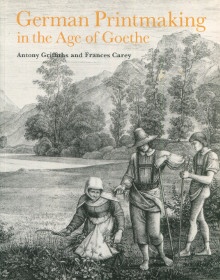
German Printmaking in the Age of Goethe
Anthony Griffiths et Frances Carrey
British Museum Press, London, 1994.
In-4, broché sous couverture illustrée, 240 pp.
Avec 150 illustrations en noir et blanc in texte.
Bon état d'ensemble.
Preface - Introduction - Kohlrausch - Technical Glossary - The Catalogue : I. Wille and his circle : Wille, Müller, Schmutzer, Weirotter, Hagedorn, Dietrich, Schenau, Graff, Klengel - UU. Berlin : Glume, Schmidt, Chodowiecki, Schadow, Rode - III. Mannheim and Munich : Fratrel, F. Müller, Kobell, Dillis, Haller von Hallerstein - IV. Vienna : Jacobe, Pichler, Clerk, Unterberger, Fischer, Russ - V. The publishers of the 1790s : Kuntz, Haldenwang, Nahl, Primavesi - VI. Idylls : Gessner, Kolbe - VII. Italy : Hackert, Rehberg, Tischbein, Gmelin, Mechau, Dies, Reinhart, Koch, Wagner - VIII. The Freiheitskrieg : Russ, Kolbe, Dahling, Thormeyer, Krafft, Schadow, Opiz, Weber - IX. The Nazarenes and their circle : Riepenhausen, Cornelius, Amsler, Barth, Overbeck, Fries - X. Munich and lithography : Strixner, Quaglio, Ramboux - XI. Romanticism : Runge, Friedrich, Schinkel, Olivier, Grimm - XII. Nuremberg and Landscape etching : Klein, Erhard, Reinhold, Richter - XIII. Goethe - Books and Periodical cited in abbreviation - General Bibliography - Index.
Ce catalogue a été édité à l'occasion de l'exposition German Printmaking in the Age of Goethe présentée au British Museum, à Londres, en 1994.
Goethe's lifetime (1749-1832) was a period of extraordinary achievement in literature, philosophy, music and art in the German-speaking world. It was indeed the Golden Age of a Germany that had no political coherence but was developing a strong sense of cultural identity.
Printmaking flourished accros the German-speaking territories from Zurich to Vienna to Hamburg, with important centres of activity beyond, in Naples and then in Rome, which from the 1790s onwards became, in effect, the main capital for artists from the politically fragmented German states. From a style that originally derived from French and Dutch prototypes, German printmakers evolved a distinctive approach of their own.